
When Venkatesh Uddameri joined Texas A&M University-San Antonio as a professor and chair of the Department of Computational, Engineering and Mathematical Sciences, he was particularly excited about the opportunity to forge collaborations and partnerships that can truly make an impact.
With some 25 years of higher-ed experience, Uddameri said many universities have distinct boundaries between disciplines, which can impede progress and success. He likes that as chair, his department brings computational science, engineering and mathematics together within a single department.
“Having everything in one place makes it really easy,” said Uddameri, who started in June.
 That structure is particularly valuable in a rapidly changing technological landscape, where artificial intelligence is transforming nearly every field. Uddameri’s research focuses on computational water resources, artificial intelligence and machine learning applications in engineering, geospatial computing, and risk and reliability analysis.
“My goal is to harness the connections between varying fields and help them advance together,” he said. “I want all the programs to grow.”
Uddameri has spent his entire academic career in Texas, including 11 years at Texas A&M University-Kingsville. Coming to San Antonio was a bit of a homecoming. His wife, a native Texan, has family in the area, and they had visited often. When the opportunity at A&M-San Antonio arose, the decision to move to the Alamo City was easy.
Today, the couple lives in the VIDA community adjacent to campus. From an upstairs bedroom, Uddameri can see the University’s distinctive dome atop the Central Academic Building.
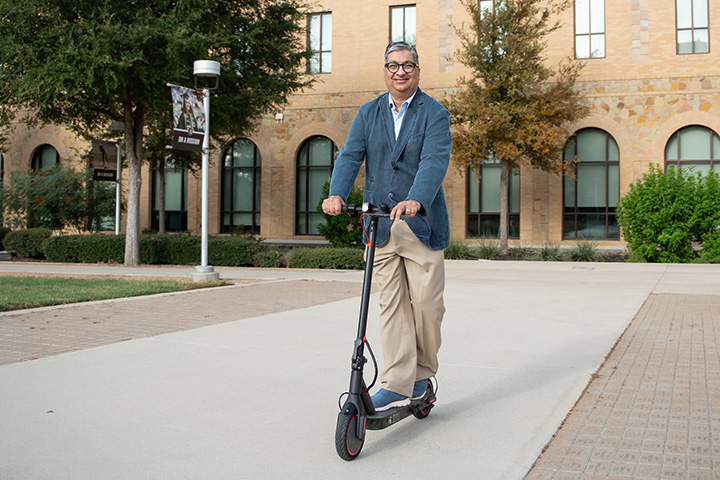
“I ride my motorcycle or scooter to campus,” he said.
Uddameri said living at VIDA is not just convenient, but it makes him feel truly connected to the University and bolsters his ability to support students and carry out impactful research. He has spent much of his career studying water resources, and he sees the region’s relationship with water as an opportunity to bring together expertise from across the University and the community.
The Edwards Aquifer, for example, stores and supplies water for more than two million people in South Central Texas. Balancing water security with economic development presents a complex challenge that cannot be solved by a single discipline.
Uddameri is also exploring collaborations with fellow faculty to study the biology, ecology and chemistry of Espada. The 380-acre property, located a few miles from campus along the San Antonio River, includes a lake and trails. The University and the San Antonio River Authority are working together to develop the property, including an outdoor research laboratory.
Uddameri sees opportunities to combine the strengths of his department with the expertise of other stakeholders at Espada, like the Department of Natural Sciences.
“We’re exploring how to combine skills in computing, biology and other disciplines,” he said.
That same interdisciplinary approach is extending into cybersecurity and water infrastructure.
Uddameri recently began discussions with the Texas Cyber Command, the state’s authority for cybersecurity operations, threat intelligence and digital forensics. Together, they are exploring ways to protect the region’s water treatment systems by bringing together expertise in hardware, software and cybersecurity.
As he settles into his new role, Uddameri is focused on using collaboration to strengthen academic programs, deepen industry partnerships and bring people together around problems that matter. He said he wants to give students the knowledge, adaptability and interdisciplinary perspectives to prepare them for a future where most challenges don’t fit within the boundaries of a single discipline.
“We can tap into our synergies and create a very collaborative environment at A&M-San Antonio where students can excel,” he said. “The amount of talent we have is just phenomenal.”