
Students from San Antonio and across the country spent much of this summer living in one of Texas A&M University-San Antonio’s residence halls to participate in an innovative research project.
The students took part in the University's National Science Foundation (NSF) Research Experience for Undergraduates (REU) program, conducting field- and lab-based research at the nearby Espada property while gaining valuable hands-on experience alongside faculty mentors.
The University received a $372,000 NSF grant last year to launch the three-year program, which provides undergraduate students with the opportunity to conduct full-time research during the summer while working closely with experienced scientists. The inaugural cohort drew more than 216 applicants for just eight available positions, highlighting the program's competitiveness and national appeal.
"This is a very competitive NSF program," said Davida Smyth, professor in the Department of Natural Sciences and the project's principal investigator. "The fact that we received this grant is a significant achievement for the University."
The first cohort included students from Georgia State University, Sonoma State University, The University of Texas at San Antonio, Palo Alto College and Texas A&M-San Antonio. Although several participants were from San Antonio, every student lived on campus for the duration of the program, creating a close-knit community centered on research and collaboration.
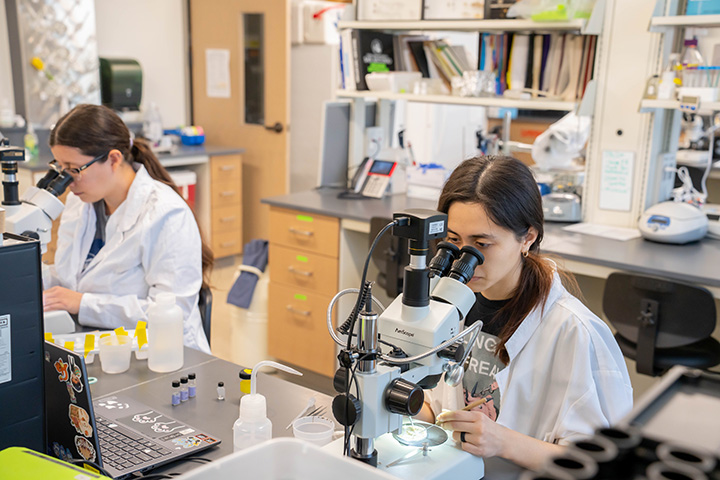 "It really is a unique program," Smyth said. "We're bringing students in from across the country to engage in research while also encouraging our faculty to work together on projects that will establish long-term ecological monitoring at Espada.”
Espada is a 380-acre property located about six miles west of campus along the San Antonio River. The research project focused on Espada’s Cassin Lake and the surrounding ecosystem, collecting baseline data that will be compared over the next three years to better understand how the area changes over time.
Taryn Bello, an A&M-San Antonio senior, was part of the REU cohort. She explained that she and her fellow researchers examined the lake’s water quality while documenting the area’s biodiversity, including native plants, insects and wildlife.
“We collected samples around the lake and brought them back to campus and tested them in the lab,” she said. “I really enjoyed being outside and working in the field. I learned so much.”
Taryn explained that one of the project's goals is to better understand how nearby commercial and residential development may influence the health of the lake and its ecosystem. Because Cassin Lake is expected to become a destination for fishing, kayaking, swimming and other recreational activities, establishing a scientific baseline now will help researchers track environmental changes in the years ahead.
Beyond the research itself, Taryn said she enjoyed living on campus with the other students. Unlike many summer research opportunities where students commute to campus, participants lived together, allowing them to collaborate long after the workday ended.
"It was really fun, especially since some of the students aren’t from San Antonio, so we got to show them around to places like the Witte Museum and the San Antonio Zoo,” she said. “We all bonded and formed a really strong connection.”
Taryn, a biology major, said the research project helped solidify her career goals after she graduates in Spring 2027.
“I discovered that I really enjoy working in a lab setting and studying microbiology. One day I’d like to work in a hospital or medical center.”
The REU project is part of a broader vision for the Espada property. In 2022, A&M-San Antonio partnered with the San Antonio River Authority to develop the site as a destination for environmental research, education and recreation. While much of the property will remain in its natural state, the University hopes to establish a low-impact outdoor laboratory and research center, while the River Authority will develop recreational and educational amenities and help maintain the lake and surrounding habitat.
For Smyth, the REU program represents the foundation for that long-term vision.
"Our goal is to create long-term ecological monitoring at Espada," she said. "This first year was about collecting baseline data. Over the next several years, we'll be able to compare those results and understand how the ecosystem evolves."
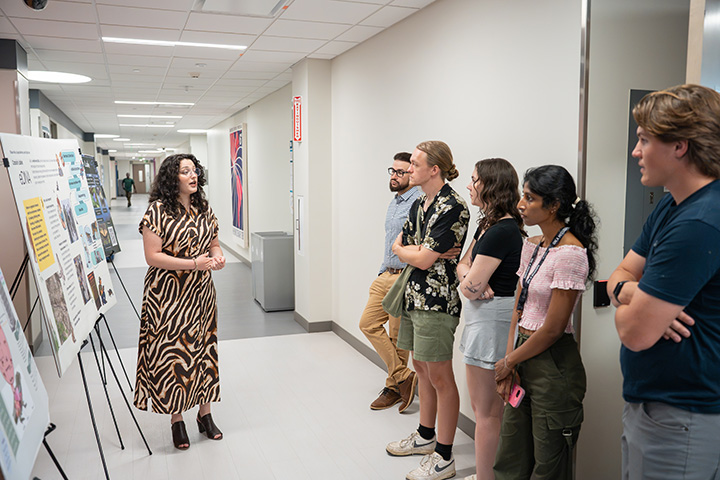
Although the 10-week program concluded last week with a special symposium that showcased the research, its impact is only beginning. Students will continue analyzing their findings, present posters at conferences and remain connected as alumni of the program. Their experiences will also help shape future cohorts through feedback and mentoring.
Looking ahead, Smyth envisions the Espada property becoming an even more robust center for research. "This is just the first step," she said. "Our long-term goal is to grow our research footprint at Espada and build something that will benefit our students, our faculty and our community for years to come."