
External grant awards reached approximately $8 million in fiscal year 2026, more than doubling the $3.6 million awarded the previous year. New research facilities and shared resources are taking shape, health partnerships are expanding, and the University is preparing to launch new academic programs that will create additional opportunities for discovery.
Together, the developments are helping position A&M-San Antonio for its next stage of growth, including its goal of achieving R2 research status.
Leading that effort is Guido Verbeck, the University’s inaugural vice president for research. A nationally recognized expert in mass spectrometry and instrument design, Verbeck is helping build the infrastructure, partnerships and support systems needed to expand research across disciplines.
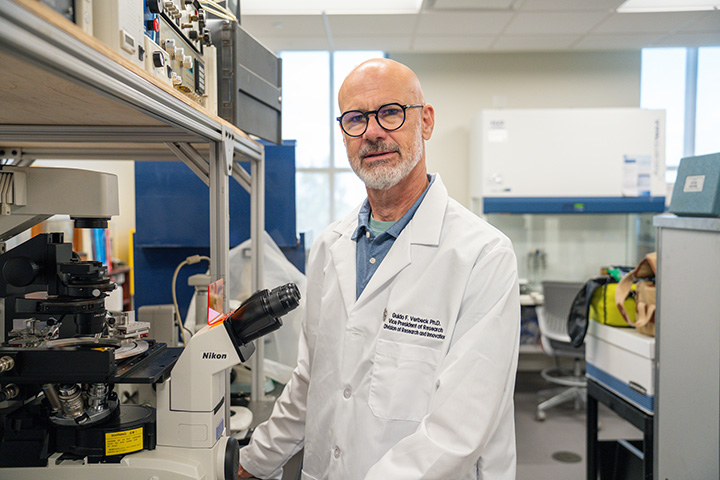
“I’m very excited about helping develop A&M-San Antonio’s research initiatives and steering them into the future,” Verbeck said.
For a university founded just 17 years ago, the pace of growth is significant.
“We are doing extraordinarily well given the age of the institution and the number of faculty that we have,” said Davida Smyth, professor of biology and chair of the Natural Sciences Department. “As we continue to build our capacity, we’ll have greater success in growing our grant awards and research activity.”
A&M-San Antonio’s R2 goal is helping guide that expansion. Under the Carnegie Classification of Institutions of Higher Education, R2 universities are characterized by significant research activity and the awarding of research doctorates. A&M-San Antonio is working toward meeting the R2 standards of $10 million in annual research expenditures and graduating 20 research doctoral students annually.
Reaching those benchmarks requires more than increasing grant awards. The University is investing in resources that allow researchers to turn ideas into sustained projects.
Verbeck is developing a network of shared research facilities in areas including genomics, microscopy, mass spectrometry and high-performance computing. The University also supports research through resources such the JagAI initiative, which supports artificial intelligence research in areas including healthcare, national defense and cloud computing.
The goal is to create an environment where faculty across disciplines can pursue ambitious ideas while giving students opportunities to participate in research alongside their professors.
One of the clearest examples of that approach is the University's growing focus on biomedical research and South Texas health.
The new Public Health and Education Building brings together academic programs, research and community partnerships, including the work of A&M-San Antonio’s Public Health Genetics and Genomics Group.
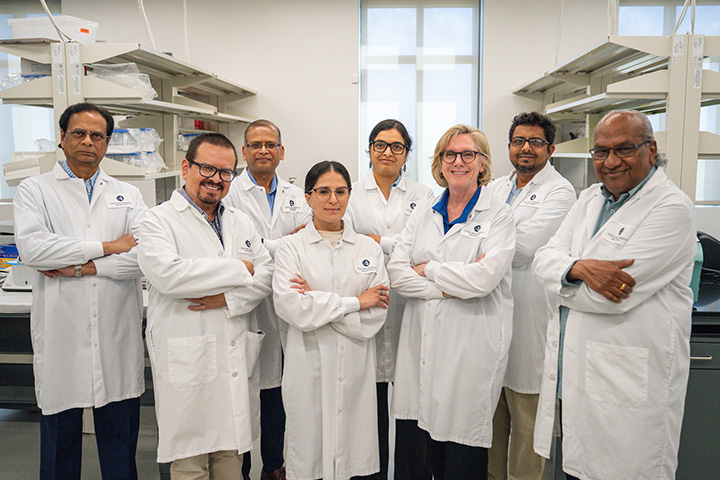
Researchers are studying health challenges that directly affect South Texas communities. A $400,000 Texas Higher Education Coordinating Board Minority Health Research and Education Grant, for example, is supporting research into childhood obesity among Mexican American youth. Another project is examining Acanthosis Nigricans, a visible skin marker associated with obesity and cardiometabolic risk in children.
“These projects exemplify A&M-San Antonio’s approach to scholarship: combining scientific inquiry with the needs and experiences of the communities the University serves,” said Srinivas Mummidi, a professor and researcher with the genetics and genomics group.
Research at A&M-San Antonio extends well beyond the health sciences.
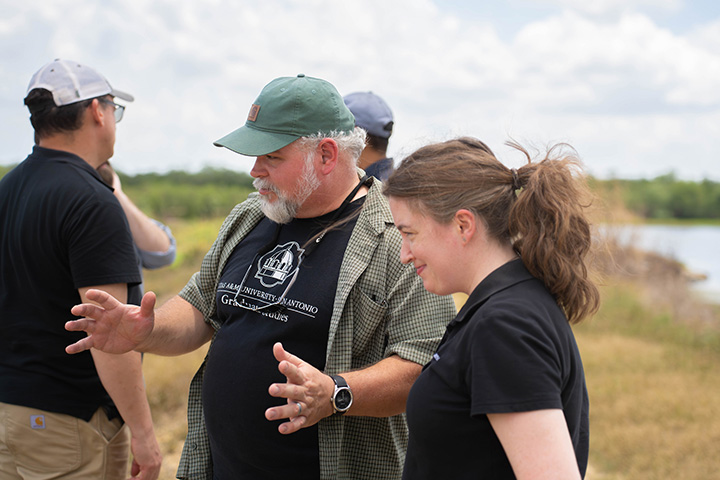
Faculty expertise spans artificial intelligence, cybersecurity, behavioral sciences, special education, conservation science, ecology and water research. The 380-acre Espada property, managed in partnership with the San Antonio River Authority, provides another setting for interdisciplinary research, from environmental studies to humanities and social sciences.
The University’s research culture is also gaining national recognition. Two faculty members —Volkan Ozbek and Claire Braaten — recently received 2026-27 Fulbright U.S. Scholar awards, creating opportunities for international research and teaching.
For students, the expanding research enterprise means more opportunities to work directly with faculty, participate in projects, and present their findings through programs such as the annual Student Research Symposium.
“Research takes many forms,” Smyth said. “It's scholarship, it's creative endeavors, it's writing books, it's writing plays. It's all of those things that we consider to be what a university is known for.”
For Verbeck, the goal is to create the infrastructure and partnerships that allow those ideas to flourish.
As A&M-San Antonio continues to grow, research is becoming an increasingly important part of the University’s identity — connecting faculty expertise, student opportunity and the needs of the communities it serves.
“For a young university with an ambitious vision, the future looks very bright,” Verbeck said, “and it’s already taking shape.”