
Students from 15 colleges and universities gathered at Texas A&M University-San Antonio recently for the 29th annual Texas Regional Ethics Bowl.
The intercollegiate competition prompts students to analyze complex ethical issues and engage in respectful discussions. Through research and presentations, students learned to evaluate different perspectives and develop persuasive arguments, while strengthening their reasoning and critical thinking skills.
 “The Ethics Bowl aligns with the University's mission to encourage students to practice engaged citizenship and participate in civil discourse,” said Matthew Mangum, a clinical associate professor in the College of Business who helped organize the event and serves on the Association for Practical and Professional Ethics' Ethics Bowl Committees representing the Texas Region.
This was the third time the University has hosted the event.
Unlike traditional debate competitions, the Ethics Bowl does not require teams to defend opposing positions. Instead, participants are evaluated on how effectively they develop and explain their opinions.
"Teams are scored on the quality of their ethical argument, not on which position they take,'' said Mangum.
Teams of up to six students representing colleges and universities across Texas and Oklahoma competed in the Ethics Bowl. The Jaguar team prepared for the competition through an applied business ethics course taught by Assistant Professor Roberto Ramirez, who served as the team's coach.
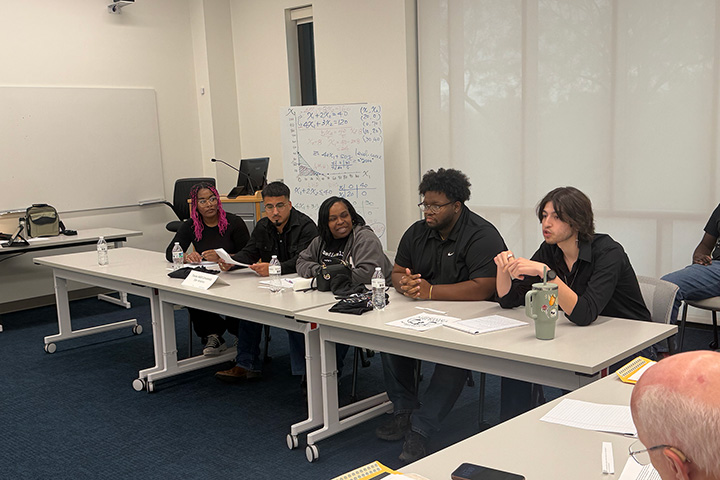 The competition consisted of three rounds, each with preassigned ethical cases. The questions that each team had to address were announced two minutes before the competition began, requiring participants to formulate responses quickly and under pressure.
"The beauty of a well-written Ethics Bowl case is that there isn’t a clear-cut answer,” said Mangum. “Students have to wrestle with complex issues, balance the interests of the parties involved, and justify their stance. And they do that while engaged in respectful discussion with another team."
The competition featured cases that examined wide-ranging issues that affect businesses, government, and society. Topics included prediction markets, deforestation in Brazil, the treatment of animals, and the growing popularity of "Looksmaxxing," an online self-improvement trend and cultural phenomenon that focuses on maximizing physical attractiveness.
Judges evaluated teams on three criteria: clarity and intelligibility, identification and discussion of central ethical dimensions, and deliberative thoughtfulness. These criteria allowed the judges to evaluate how clearly participants communicated their arguments, identified the main ethical issues with each case and thoughtfully considered different perspectives before declaring their decision.
The University of Houston, Baylor University, and the University of Texas Rio Grande Valley were the competition’s top three schools and will go on to the national championship.
Mangum said that through events like the Ethics Bowl, students develop skills that are beneficial to their future careers, including critical thinking, communication, collaboration and decision-making.
“We are living in a time of heated rhetoric in the political sphere, on social media, and in other contexts,” Mangum said. “Having students take the time to think through nuanced issues and then have a civil conversation with their peers is a valuable experience for them both personally and professionally.”