
The number of public-school students in the United States who speak English as a second language has dramatically increased since the turn of the century. However, attracting and retaining enough teachers to meet non-native English speakers' (or English learners) needs remains a significant challenge.
Three professors at Texas A&M University-San Antonio are addressing this need through an initiative known as ASAP2Teach.
“We want to be a national hub for the creation of bilingual and ESL educators and education,” said Esther Garza, principal investigator of the ASAP2Teach Project, professor of bilingual and ESL education, and chair of the Department of Educator and Leadership Preparation. Hsiao-Ping Wu, professor of bilingual education, and Myriam Jimena Guerra, associate professor of bilingual education, co-lead the program.
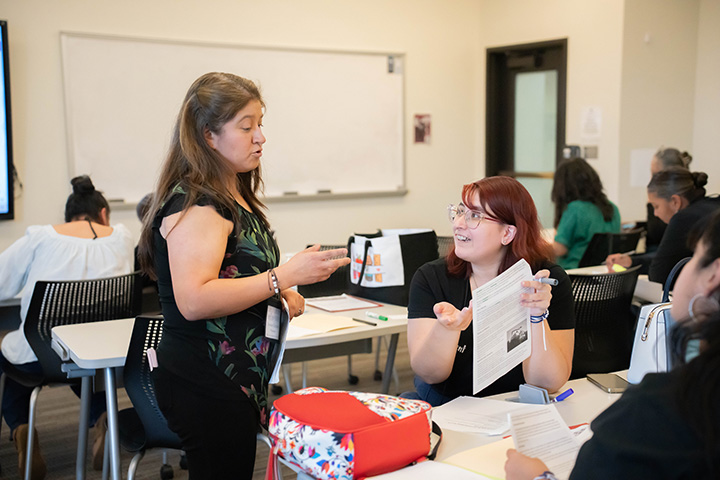 The trio helped oversee the recent ASAP2Teach 3rd Annual Multilingual Conference. The event was held on campus and drew about 120 educators who discussed topics ranging from unlocking potential in multilingual learners to leveraging AI to strengthen student language assets.
A&M-San Antonio was awarded a four-year, $1.5 million Augustus F. Hawkins Centers of Excellence Program grant from the U.S. Department of Education in 2023 to launch the program. The funds support scholarships and resources to boost the number of multilingual teachers, including helping cover the costs for educators to take statewide certification exams, as well as the cost of the annual conference.
Bilingual education efforts are primarily focused on native Spanish speakers, who represent 76.4% of all English Learner students (ELs), according to the National Center for Education Statistics. English learners are among the fastest growing population of students in K–12 schools, growing by 15% between 2011 and 2021. States along the Mexico border in the Southwest and West have the most ELs.
However, 55% of educators told EdWeek Research Center that the number of staff in their district or school who have been appropriately trained to serve non-native English speakers is insufficient. Small and rural school districts face the toughest EL staffing challenges, EdWeek reported.
These struggles hit home in the greater San Antonio region. According to a study by Preply, an online global tutoring marketplace and language-learning platform, nearly 30% of San Antonio residents are bilingual, placing the city fourth among the most bilingual regions in the U.S.
A&M-San Antonio’s student body reflects the country’s evolving demographics. Approximately 65% of the University’s more than 7,600 students identify as Hispanic or Latino. Furthermore, 66% of its students are first-generation undergraduates and 97% of alumni remain in Texas after graduation, expanding the impact that University programs like ASAP2Teach have on local and regional communities.
The language initiative is also personal to Garza, Wu, and Guerra. Wu and Guerra are immigrants to the U.S., and Garza’s parents were as well. They know firsthand the importance of strong communication skills.
“We think of languages as assets and how language can enrich your life,” said Guerra.
To create a lasting impact, the ASAP2Teach project also includes outreach to local high schools and middle schools in hopes of convincing students to join the junior Bilingual Education Student Organization (BESITOS) at their schools. The three partnering public school districts are Harlandale, Southwest, and Edgewood.
“We focus on south San Antonio because the need is so high,” Garza explained.
Wu shared that among local public-school children and teens, the program expands beyond the mechanics of learning a language to the communities and people behind the words.
“When you learn the language, you don't just learn the alphabet. You really learn the culture,” she said.
Activities include learning about the history and family traditions associated with tamales and highlighting influential Latino cultural figures, such as Mexican artist Frida Kahlo.
The next step for ASAP2Teach is to ensure the effort is sustainable once the grant money is exhausted. Guerra, who runs the annual conference, is already looking into avenues to keep the event’s costs down should they be forced to charge admission (the event is free currently). Garza added that she and her team will continue to apply for grants and seek out donors and sponsors.
Bilingual education needs will continue to grow, all three faculty members agreed. “We can’t deny we are living in a bilingual, multilingual society,” said Wu.