
Derek Kubacki, who earned his B.A. in history from A&M-San Antonio in 2018, recently donated a miniature leaf, or parchment sheet, from a 500-year-old religious manuscript from France to the University. The sheet, written in Latin, was part of the Book of Hours, a prayer book made in Paris by Francois Barbier in the late 15th century.
Kubacki purchased the miniature manuscript leaf through an online art auction in 2022. He said he was awestruck when he first saw the rare artifact.
“I knew that I wanted to try and get it because I love art and I love history,” Kubacki said. “Here is a piece of parchment that’s well over 500 years old that has seen countless stains in its lifetime. I wanted to be able to have it and display it.”
Kubacki said he never had the opportunity to display the item in his house. When he was moving this summer to take a position as an academic advisor at George Mason University in Virginia, Kubacki decided to gift the manuscript leaf to A&M-San Antonio.
“I didn’t want to take it across 1,300 miles and have it not properly displayed,” Kubacki said. “Who better to give it to than my alma mater, which can potentially use it to consider how art, history and religion all come together in the development of nations."
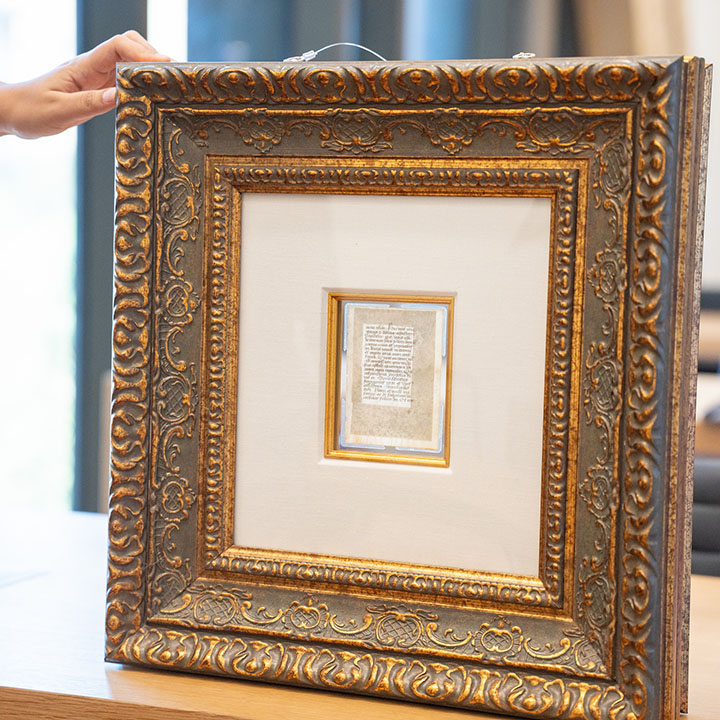 The artifact is now in the University Library’s Archives, according to Leslie Sitz Stapleton, head of Archives and Special Collections.
“Mr. Kubacki's extraordinary gift will enrich the University’s archives not only as an important historical artifact, but also as a resource for the study of art, religion, history, literature, and language,” she said. “A single illuminated page has the power to open conversations across centuries and academic disciplines. Objects like this remind us that archives do more than safeguard the past. They create opportunities to discover, question, and connect with it.”
William Kiser, a professor and chair of the Department of History, Philosophy, and Geography, said the miniature leaf is now accessible for students, faculty and staff to view.
“This is unique to our campus,” Kiser said. “It has survived countless reformations, civil wars in Europe and throughout France, and two World Wars. Now it’s helping build a collection of historically significant manuscripts and artifacts that can be integrated into classroom use.”
Kiser said the historical artifact can be utilized in courses throughout multiple disciplines.
“There are many fields that will benefit from having the manuscript available, which makes it all the more important in terms of student engagement and their coursework,” he said. “It is now available for students to examine in the greater context of human history.”
This is not Kubacki’s first gift to the University. Eager to share his passion and love of history with fellow Jaguars, he partnered with the University last year and helped launch the first alumni-funded endowed history lecture series.