
A group of A&M-San Antonio students had an unforgettable experience this summer when they traveled to Taiwan, where they gained new language skills while broadening their cultural understanding and global perspective.
The students were among a select group from across The Texas A&M University System chosen to participate in the 2026 UAAT–TAMUS Mandarin Project, a collaborative educational initiative between the University Academic Alliance in Taiwan (UAAT) and the Texas A&M System. The program supports students as they study Mandarin Chinese while immersing themselves in Taiwanese culture through academic coursework, cultural activities and guided excursions.
Among the participants was David Esquivel, an accounting major who is scheduled to graduate this fall.
One of the San Antonio native's favorite experiences was visiting Sun Moon Lake, Taiwan's largest alpine lake, nestled in the foothills of the Central Mountain Range. The popular destination is surrounded by temples and is home to the Indigenous Thao people.
"It was so beautiful," David said.
Another highlight was forming a friendship with a student from Prairie View A&M University.
"We became really close friends," he said. "We got to experience some amazing things together, which made the trip that much more special."
For cyber engineering technology major Juan Gonzales, the program marked a return to a place that had already made a lasting impression.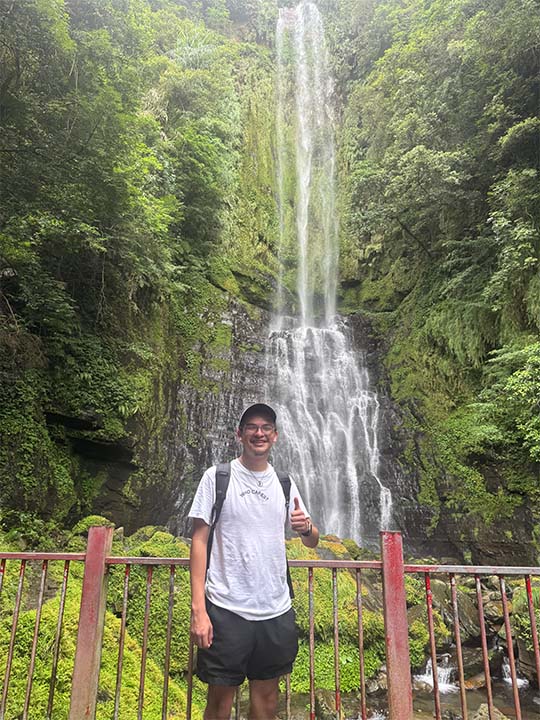
As a freshman in 2024, Juan participated in an A&M-San Antonio study abroad program in Taiwan and, he said, "fell in love with its culture."
When he learned about the UAAT-TAMUS Mandarin Project, he immediately applied. After completing the two-week program, Juan received an additional Mandarin Project scholarship that allowed him to extend his studies in Taiwan through Aug. 22.
He is living in a residence hall in Taipei while continuing to study Mandarin and exploring museums, temples and other cultural sites with support from the National Chung Hsing University's Office of International Affairs.
"Taiwan is such a charming place, with all these beautiful mountains," he said. "Geographically, it's very different from Texas, but it has that same 'big-small town' feel as San Antonio, with people who are really kind and supportive."
Juan hopes to earn a master's degree after graduating this fall and eventually pursue an international career in big data, building, maintaining and analyzing complex datasets.
"This is definitely an experience and opportunity like I've never had before," he said. "It's been so rewarding."
For this special opportunity to travel abroad, Juan, David and the other University students had a unique mentor in Associate Professor Chin-Yen Liu, who was born and raised in Taiwan. Although the program is not a University-sponsored study abroad experience, she volunteered to help prepare the A&M-San Antonio students before their departure. She also visited with the students during their time in her home country.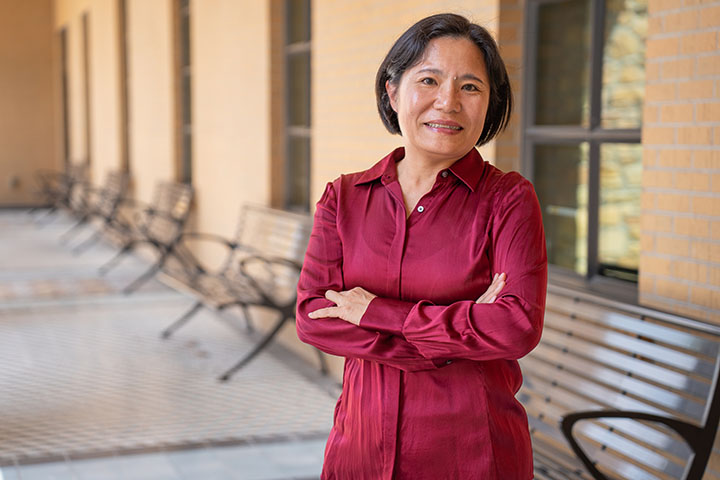
"When students are interested in going to my country, I feel compelled to support them," Liu said. "I know many of our students have never traveled outside the United States, so going to another country can be both exciting and intimidating."
Liu, who has taught at A&M-San Antonio since 2011 and previously led faculty-sponsored study abroad programs to Taiwan, met with the students before they departed in May to discuss travel preparation, cultural expectations and practical tips for living abroad.
Six A&M-San Antonio students participated in the two-week program, representing half of the 12 students selected from across the Texas A&M System.
Weekdays began with three hours of intensive Mandarin instruction each morning, followed by afternoon cultural activities. On weekends, host universities organized excursions to historical landmarks, cultural sites and scenic destinations across Taiwan.
The students were based primarily in Taipei, Taiwan's capital city, while also traveling to Taichung, where Liu had the opportunity to introduce them to her hometown.
Unlike many international education programs, the UAAT-TAMUS Mandarin Project is open to students from any academic discipline. There are no language prerequisites or major requirements, reflecting the program's broader goal of preparing globally minded graduates regardless of their field of study.
The initiative also removes many of the financial barriers that often prevent students from studying abroad. The program covers tuition for Mandarin instruction, lodging and organized cultural activities, leaving students responsible only for airfare, meals and personal expenses.
The Mandarin Project is part of the broader U.S.-Taiwan Education Initiative, which promotes academic collaboration between universities in Taiwan and the United States. Through the partnership, UAAT's 12 member universities and the 13 universities within The Texas A&M University System are expanding opportunities for language education, student exchanges, collaborative research and academic partnerships in fields including engineering, agriculture, health sciences and emerging technologies.
For A&M-San Antonio students, the experience offered far more than language instruction. It challenged them to navigate unfamiliar environments, build confidence and gain a global perspective that will benefit them long after they return home.