
 Dr. Berenice de la Cruz was recently bestowed with a first-of-its-kind honor recognizing her innovative work as a teacher and therapist. During the Texas Association for Behavior Analysis (TxABA) annual conference, she received the Inaugural Behavior Analysis Trailblazer in Texas Award.
The award recognizes individuals who have advanced behavior analysis into new domains across the state through innovation, leadership, and sustained impact. For de la Cruz, assistant professor and coordinator of the Applied Behavior Analysis (ABA) Program at A&M–San Antonio, the recognition reflects years of work building pathways to culturally responsive care, expanding bilingual training, and creating access to services for families historically underserved by the field.
“This award is recognizing the creation of the Applied Behavior Analysis Program at our University,” de la Cruz said. “We designed it specifically to serve the South Side and first-generation students and to prepare them to meet the needs of the communities they come from.”
Launched in 2022, A&M–San Antonio’s ABA program offers both bachelor’s and master’s degrees with a concentration in autism spectrum disorders—the area of greatest need within the profession. But from the start, de la Cruz envisioned something more than a traditional program.
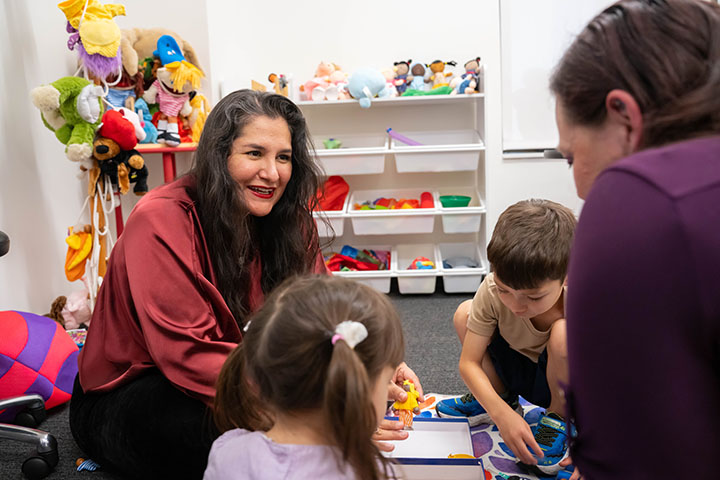 “I have a large number of students from our area, many of whom are already working in South San Antonio school districts,” she said. “We know exactly who they’re going to encounter in their careers. That’s who we prepare them for in our coursework, assignments, and community partnerships. This type of training needs to happen.”
Her approach integrates culturally adapted practices, bilingual preparation, and hands-on experience in local schools and clinics. Students begin serving the community while still in the program, working under supervision in roles similar to paraprofessionals in education. By the time they graduate, they are prepared to sit for board certification, obtain licensure, and step directly into leadership roles as behavior analysts.
That workforce pipeline is critical as demand for ABA services continues to rise. According to CDC studies, autism diagnoses have increased steadily over the years. In Texas, the need intensified after ABA therapy became a Medicaid-covered benefit for autism, removing a major barrier for families but increasing pressure on an already limited provider base.
“There are still many access barriers, and simply not enough providers,” de la Cruz said. “Our students are helping fill that need now, while they’re training, and they’re ready to step into those roles as soon as they’re certified.”
Her leadership extends well beyond campus.
Born in Mexico and raised along the border, de la Cruz has long worked with bilingual families. When the Behavior Analyst Certification Board announced in 2020 that international certification would be phased out in favor of country-specific systems, she saw both a challenge and an opportunity.
She began collaborating with colleagues in Mexico to build professional infrastructure for the field there. Together, they developed continuing education, professional standards, and ultimately, a certification process specific to Mexico.
“That work was important to me because of my background and because of the bilingual communities I’ve always served,” she said. “We’re working to make sure behavior analysis can grow in ways that fit the cultural and educational context of Mexico.”
 Last summer, her impact reached Costa Rica, where she was invited by the country’s Ministry of Education to provide the first-ever ABA training for teachers and teacher-trainers. Over three days, de la Cruz trained educators not only to apply behavioral strategies in classrooms, but to teach those strategies to others.
“They didn’t just need to learn how to do it,” she said. “They needed to learn how to teach it.”
These cross-cultural efforts, along with her work in Texas, were highlighted by the TxABA Awards Committee when selecting her as the inaugural Trailblazer awardee.
De la Cruz’s influence within the profession is also evident in her service to TxABA itself. A longtime member, she currently serves as president of the organization, which represents roughly 1,300 members and draws more than 1,200 attendees to its annual conference.
“We’ve worked hard on policy that improves access for families, including those on Medicaid,” she said. “That advocacy is part of what helps make programs like ours so meaningful, because our graduates are stepping into a system where those services are increasingly available.”
For A&M–San Antonio, the award underscores the role the University’s ABA program plays in preparing professionals who reflect and understand the communities they serve.
“This recognition shows that culturally responsive, community-centered training matters,” she said. “Our students aren’t just learning theory. They’re building relationships, working with bilingual families, and gaining the cultural competence that’s essential in this field.”