
James Finley has always been in love with books and literature. Growing up in New York City, he was particularly fascinated by Henry David Thoreau, a 19th-century writer who explored themes like how to live an authentic life, our connection to nature, and the impact of race on American life. Now, in what he calls a dream come true, Finley is featured in a new PBS documentary about Thoreau, produced by iconic filmmaker Ken Burns. The documentary was released on March 30.
“It’s a huge honor,” said Finley. “Thoreau’s work has always resonated with me, and I’ve watched Burns’ documentaries over and over again. To be part of this project is just mind-blowing.”
Celebrating his 10th year at A&M-San Antonio, Finley is an associate professor who teaches classes on 19th-century American literature, environmental literature, English Language Arts pedagogy, and disability studies. His academic focus on Thoreau has been a defining thread throughout his career.
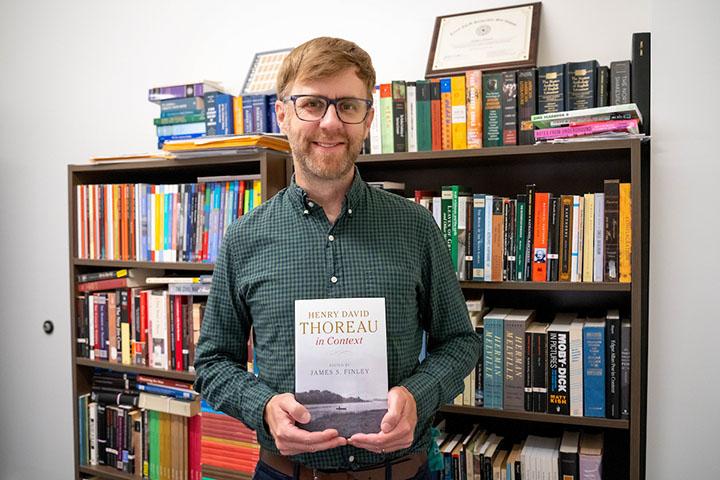 In addition to writing several articles and book chapters about Thoreau, he edited “Henry David Thoreau in Context,” published in 2017, and served as a trustee of the Thoreau Society (now called the Thoreau Alliance), the oldest and largest organization devoted to the author, where he edited the society’s quarterly newsletter. He’s currently co-editing “The Oxford Handbook of Henry David Thoreau,” and his forthcoming book, “Abolition and the Rise of US Environmentalism: The Literature and Politics of Free Soil,” which has a chapter on Thoreau, is coming out this summer.
Finley’s work caught the attention of the team producing the Thoreau documentary, and they reached out to him in 2021. The following year, he met with producers at the Thoreau Alliance’s Annual Gathering in Concord, Massachusetts, where the author lived for most of his life.
“They invited me to fly out to Boston to film my part for the documentary,” Finley said. “I was also brought on as a consultant and helped review the script.”
Set against the political and social tensions of the mid-19th century, the three-hour, three-part film traces Thoreau’s journey from his early days in Massachusetts to his deep engagement with the moral crises of his time, including industrialization, slavery, war, and environmental degradation. By examining some of his most iconic works, such as “Walden” and “Civil Disobedience,” the film explores how Thoreau was a brilliant but flawed writer who helped define modern environmentalism and nonviolent resistance.
Burns, an Emmy Award-winning filmmaker, has produced dozens of documentaries on topics ranging from sports and music to war and health. He co-produced the Thoreau documentary with Don Henley, a founding member and lead singer of the Eagles. The film is narrated by George Clooney, and voiceover talent includes Ted Danson, Tate Donovan, Jeff Goldblum, and Meryl Streep.
Finley points out that Thoreau was not successful during his lifetime, and that it was decades after he died in 1862 that his work began to gain popularity and influence.
“He spent his whole life trying to find work that he found meaningful,” Finley said. “He never had much money, but he wasn't looking for that. He wanted to live his life, be true to his values, and explore the world. Thoreau’s writing helps us think about the challenges and joys of modern life. He doesn't necessarily try to provide answers to life’s big questions, but rather he gets us to think about the questions themselves.”