
During my time as a student worker with A&M–San Antonio’s Division of Strategic Communications, I was tasked with a unique opportunity to explore the University’s Library Innovation Lab and surprise them with what I could create.
Located on the library’s first floor, the lab gives students, faculty, and staff a space to collaborate with others, get hands‑on experience, and learn in a way that feels fun and approachable.
“I think it’s exciting that we have this resource that helps the campus community expand their education and creativity,” said lab staff member Gideon Ramirez, who assists guests with their projects.
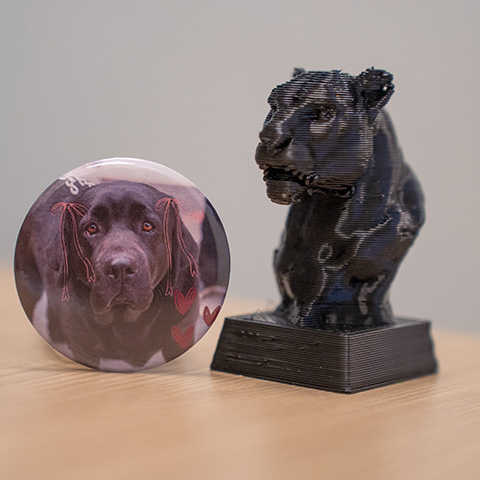
For my first project, I used the lab’s LulzBot Taz Pro 3D printer, which can produce everything from simple shapes to complex parts and components. With Ramirez’s help, and some design support from the team, I printed a 3 1/2-inch black Jaguar head with a base inspired by, of course, the University’s mascot General. Go Jaguars!
The process began by completing a request form describing what I wanted to print and how much filament I would need. Not familiar with 3D printing, I learned that filament is a special plastic that softens when heated and solidifies as it cools, and Ramirez was available to help me with recommendations on how much I would need, what color to use, and more.
The request form also requires uploading a digital file of the item you want to print. Once again, Ramirez assisted with the process, including providing details about what file types they could use. The printing process took about an hour as the Jaguar head slowly formed, layer by layer. It was fascinating to watch. Once the print was complete, the lab provided finishing tools to smooth and polish the final product.
The cost of a 3D print depends on the project’s weight in grams, the type of filament used, and whether the print is single- or multi-color. The minimum cost for any project is $3 – that's not a bad deal if you ask me.
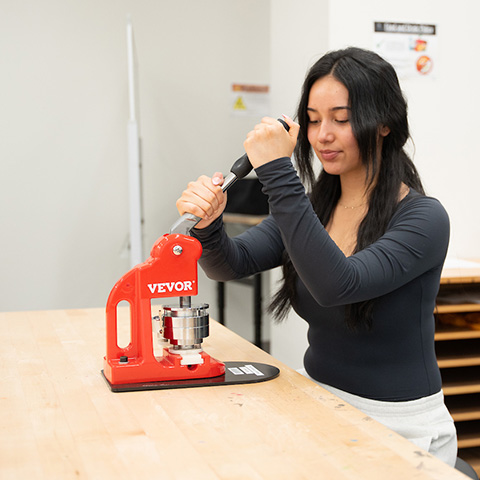
Next, I used the lab’s Vevor button-making machine to create a button featuring Scout, A&M–San Antonio’s beloved victim assistance dog who works with the University Police Department. Ramirez guided me through the process, which began with creating a 2.5-inch image of Scout, slightly larger than the final button size. The lab supplies the remaining materials, including the metal button shell, the clear mylar cover, and the plastic backing with a pin.
I was able to place the materials into the machine’s upper and lower molds. The artwork is then sandwiched between the metal shell and mylar, and pressing the handle secures all the pieces together. I made a few different designs, and now the team and I are sporting some adorable Scout-fan club buttons. The minimum cost to make a button is $1.
The Innovation Lab offers several other services, including large-format printing for signs, banners, and posters. Guests can also use a laser cutter and engraver to create designs and small items from wood, acrylic, leather, and cardboard. Laminating services are available for items up to 23 inches wide. There’s so much it has to offer.
The Library Innovation Lab is a campus resource that provides tools and activities to foster your creativity. Whether you need these items for a class, just have a fun idea you want to bring to life, or maybe even want to start a button company, my advice is to visit the Innovation Lab. My experience was both enjoyable and educational, and Ramirez made the process simple and fun.