
You wouldn’t know it by looking at them now, but twin brothers Keith and Ken Hutchins were “skinny as a rail” midway through high school. Their passion for building their muscles led them on an academic journey in which they’ve flexed some serious brain power.
In December 2025, Keith took first place and Ken was runner-up for research presentations at the 2025 Texas Association of Health, Physical Education, Recreation and Dance Annual Convention (TAHPERD) in Fort Worth, Texas.
The success continues a strong run for Texas A&M-San Antonio’s Health and Kinesiology Program, which annually sends its top students to conventions showcasing academic pursuits, according to Dr. John Smith, a professor in the Department of Counseling, Health and Kinesiology.
The top two placements are a shared accomplishment for the twins. They collaborated on both projects—studying the relationship between handgrip strength and overall health and the effectiveness of electromyography (evaluating nerve and muscle health by recording electrical activity) performed regularly at Texas primary schools.
Keith’s presentation on handgrip strength edged out his brother’s exercise-based poster. If there is sibling rivalry or jealousy, none is apparent. Both appear more excited about the skills and knowledge they’ve picked up from Smith’s hands-on approach to learning kinesiology.
They say the projects are the crowning achievement of their college career, which wraps up this semester with a pair of 4.0 GPAs.
“If I had to pick one favorite experience from college, it would be this without a doubt,” said Keith Hutchins.
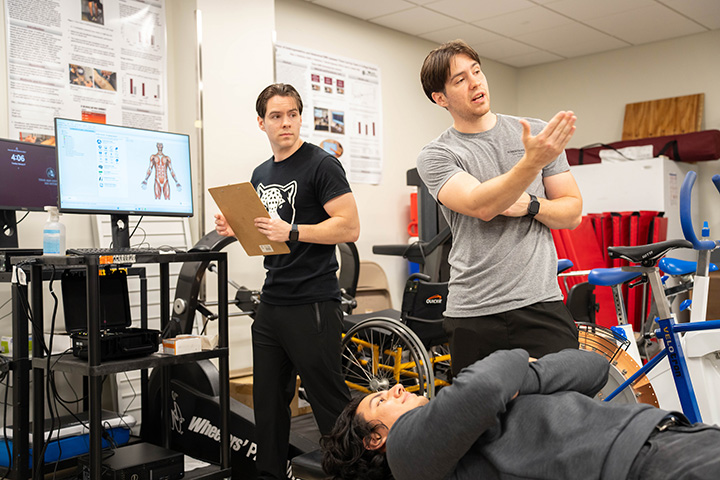 At A&M-San Antonio, roughly two-thirds of students pursue exercise science-related careers, while one-third focus on physical education, said Smith.
Fittingly, the University’s kinesiology program has grown at a healthy pace since its inception in 2008, when Smith was hired. Back then, there were just 12 students. Today, 450 undergraduate students are majoring in kinesiology. There is also a graduate progam that helps graduates gain a more critical understanding of theory, practice, and advanced research.
A Kinesiology Club augments the coursework and proves to be a valuable fundraiser supporting key activities such as convention competitions at TAHPERD and the Texas Chapter of the American College of Sports Medicine (ACSM). Each year, Smith engages 10–15 students to conduct Institutional Review Board-approved research projects that must be professionally presented.
Kinesiology Club President Kassady Salazar is among the students selected for ACSM, scheduled for February 26-27 in Waco. She will present her research on whether wearing pneumatic compression boots can delay or prevent muscle soreness after exercising.
“It was a fascinating learning experience,” she said.
That’s the point, said Smith.
“The whole idea is teaching the students about the research process and how to go step-by-step, following the scientific method of problem solving and doing things in an ethical manner,” he said.
Those lessons extend beyond kinesiology, proving valuable in any school project, to say nothing of professional environments, adds Smith.
The rise in interest in kinesiology aligns with two larger national trends: Americans are living longer and a general interest in wellness. Aging well has become a keen focus among medical professionals who see the connection between physical activity and mental and emotional health.
Grip strength is a quick way to read much into an individual’s wellbeing, noted the Hutchinses. “Grip strength can tell you about brain injuries, mental health, and many other health issues,” said Keith.
Just as the brothers see grip tests as an efficient way to evaluate older people, they found room for improvement among standard exercise assessments. “I’d love to see the military sit-up replace the curl-up in schools. That’s something I’m already thinking about using in the classroom,” Ken said.
The twins are already looking ahead to becoming physical education teachers and then heading to graduate work with some real-world experience. Meanwhile, Salazar has found her passion in physical training, a calling that began when she injured her knee playing softball in high school. She hopes to start graduate school in the fall.
Smith said the trio is in a strong position to accomplish their goals after completing traditional coursework and field training through their research projects.
“The students who take leadership roles, attend conferences, and conduct research are usually very successful,” he said. “The department’s experiential learning model gives students résumé-building opportunities before graduation.”