
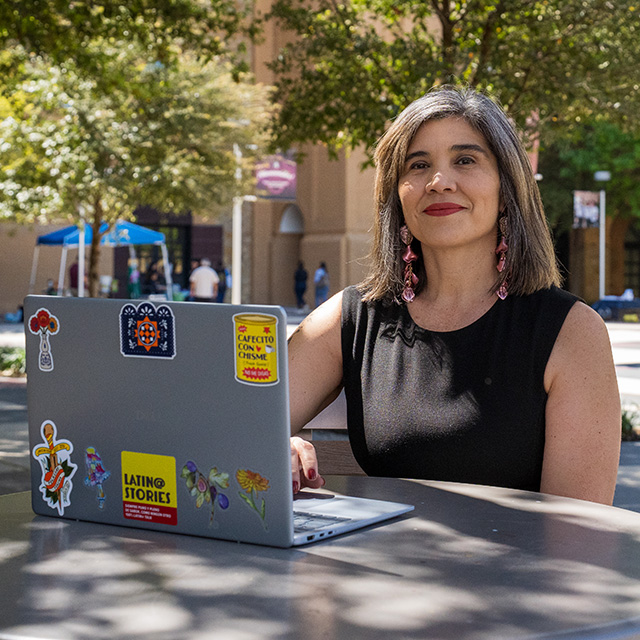
Throughout her 20-plus years as an educator and researcher, Dr. Elena Foulis has centered much of her work around examining Latina/o/e voices through oral history, linguistic practices, and cultural studies.
During this time, she has learned that most educational resources, such as school textbooks, typically have few, if any, Latina/o/e community perspectives. But these communities often have rich cultures with varied perspectives, which is a valuable resource for oral historians and researchers.
 By “listening deeply,” Foulis said, oral historians can better understand how specific time periods unfolded in communities, including conditions and influences that either helped or hindered families from retaining Spanish as their dominant language.
With such keen insight and decades of experience, Foulis, an associate professor and director of Spanish Language Studies, was recently elected to the board of directors of the Texas Oral History Association (TOHA), an organization of oral history practitioners who promote the use of professional interviewing and archiving standards.
As a TOHA board member, Foulis supports the practice of oral history as both a pedagogical tool and a method that helps preserve the histories of local communities. In her role, she will disseminate information about best practices and provide resources to other oral historians, such as association workshops that focus on new trends and techniques, like using AI when working on transcripts.
She will also use her experience to help develop programming for the association’s fall conference at the University of Texas at El Paso. The event brings together professionals to share oral history research through presentations and networking.
“It's another way that we connect and see the work that we as oral historians are doing across the state and then share that with a national audience,” she said. “We’re helping ensure these stories and cultures are not lost.”
Foulis, who joined A&M-San Antonio in 2022, ramped up her focus on oral history during her time teaching at Ohio State University. She documented the experiences of her community as a way to provide content for her classes and to see if the experiences of other local Latina/o/e community members mirrored hers.
“It became an oral history project, not only to bring content to the class, but also as a way to train students on how to do this work,” she said. “It was about how to ethically work with Latinx communities. How do we interview? What is the process of doing this in a respectful, ethical manner?”
As part of this experience, Foulis noted that many times, stories from elders or everyday people are not seen as worth studying. Yet when you pay attention and listen deeply, it’s evident these community members have lived full, complete lives that can provide unique perspectives that a textbook can’t truly convey.
Foulis also noted that her students bring “cultural wealth” into the classroom by sharing the ways they learn the history of their family or community.
“When students come into our classrooms, they're not a blank page. They have so much knowledge,” she said. “Those experiences inform our work and the way that we work with other communities.”
Dr. Foulis also has a new book on oral history titled Embodied Encuentros: Oral History Archives of Latina/o/e Experiences with the Ohio State University Press. The book will be available in April 2026.